

Build muscle is the top goal in our data: 66.9% of the 52,804 people who took The Movement Athlete’s fitness quiz between January 2021 and October 2025 ticked it, with “get strong” second at 59.5%.
Just over half (52.5%) also ticked at least one body area in the quiz’s pain-areas question, led by shoulders (25.3%) and wrists (20.6%). That share climbs with age, from 47.1% of 13–17-year-olds to 61.7% of people aged 65–90.
Below you’ll find the full tables, who is starting calisthenics, a separate 2026 dataset on what stops people training (1,206 answers), what we’d do with these findings as coaches, and exactly how we counted.
By The Movement Athlete Coaching Team. Data: Jan 2021–Oct 2025 quiz, and Aug–Nov 2026 quiz; published 12 Nov 2026.
Key calisthenics statistics at a glance
- 66.9% want to build muscle; 59.5% want to get strong; 44.4% want to learn skills (n = 52,804, 2021–2025, multi-select).
- People pick 2.87 goals on average. Only 25.3% pick a single goal.
- 52.5% ticked at least one pain area, and 36.5% ticked a shoulder or a wrist.
- Women ticked a pain area more often than men: 60.7% vs 50.3%.
- People who rated themselves “not fit at all” ticked a pain area most often: 62.3%, against 49.1% of “very fit” respondents.
- 40.2% want workouts of 30 minutes or less. The median request is 45 minutes.
- In our 2026 quiz (n = 1,206, Aug–Nov 2026), the top obstacles were “Can’t stay consistent” (31.7%) and “Don’t know where to start” (31.1%). Schedule came last at 5.4%.
What people want from calisthenics training
The quiz let people tick as many goals as they liked, so the first column below adds up to more than 100%. The second column is the cleaner signal: it counts only the 13,359 people (25.3%) who ticked exactly one goal, so it shows what people want when that’s the one thing they ask for.
| Goal (quiz option) | % of all respondents (n = 52,804) | % of single-goal respondents (n = 13,359) |
|---|---|---|
| Build muscle | 66.9% | 30.5% |
| Get strong | 59.5% | 20.9% |
| Learn skills | 44.4% | 14.0% |
| “Become mobile & pain-free” | 42.4% | 7.0% |
| Be healthy & fit | 40.3% | 13.7% |
| Lose weight | 33.8% | 14.0% |
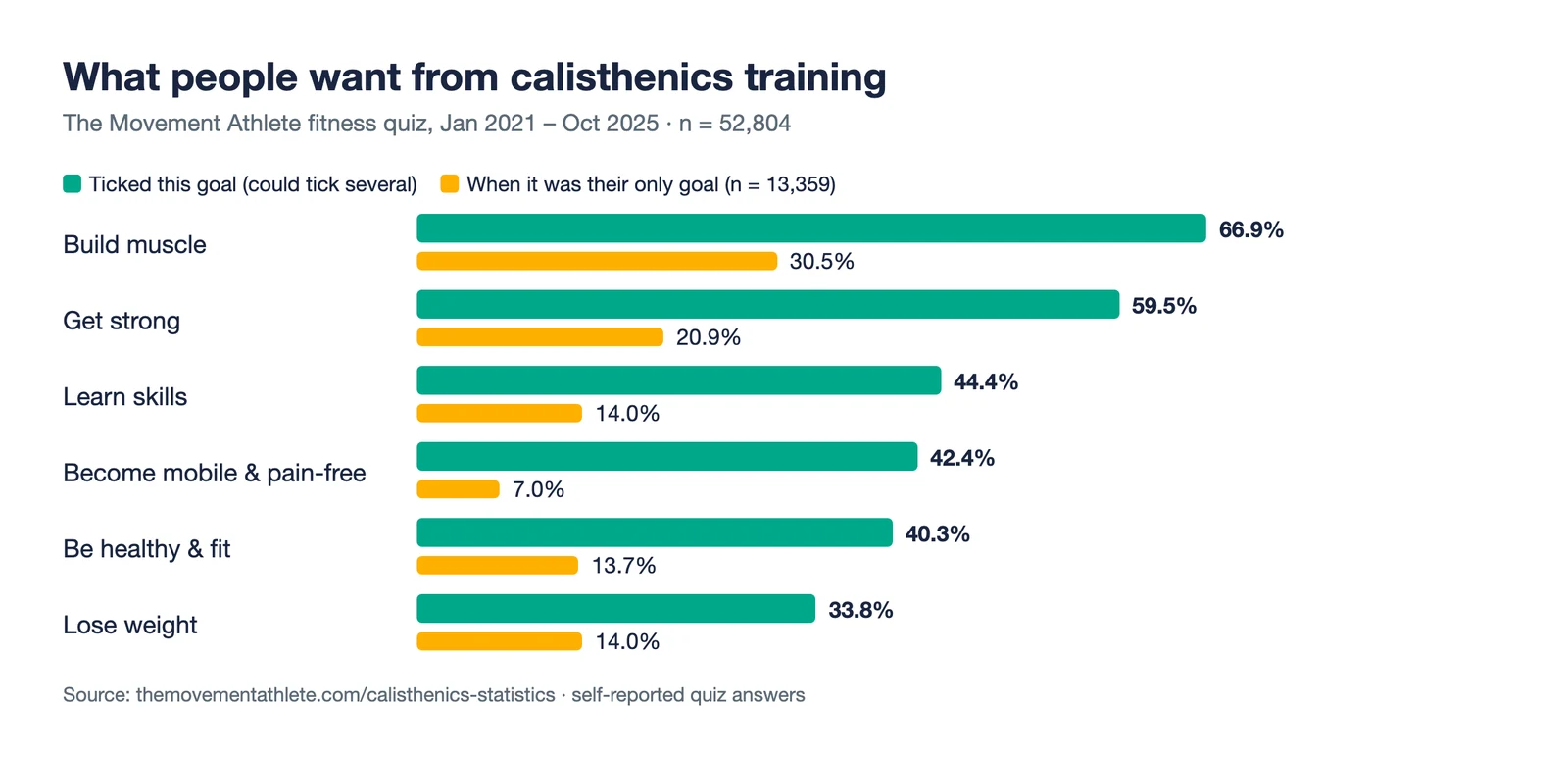
Muscle and strength lead in both columns. But look at the “become mobile & pain-free” option: 42.4% ticked it, yet only 7.0% of single-goal people chose it alone. People who want mobility mostly want it alongside other goals, not instead of them.
Goals change with age
Skills matter most to the youngest quiz takers, mobility peaks in midlife, and health matters more in the older bands.
“Learn skills” falls from 53.9% at 13–17 to 19.1% at 65–90. The “become mobile & pain-free” option climbs from 29.9% at 13–17 to 51.5% at both 35–44 and 45–54, then falls to 41.4% at 65–90, while “be healthy & fit” goes from 32.0% to 55.6%.
Where it hurts: pain areas by body part and age
One caveat first. We couldn’t recover the exact on-screen wording of the pain-areas question, and the question was optional. A blank answer could mean “nothing hurts” or simply “skipped”. So these figures mean ticked at least one pain area. They are not injury rates, and they are not a diagnosis. No clinician reviewed this page; it reports quiz answers, not medical findings.
Read that way, 27,729 people (52.5%) ticked at least one area, and those who did ticked 2.3 on average. Here’s how often each area was ticked, as a share of all 52,804 respondents:
- Shoulder 25.3% · Wrist 20.6%
- Hip 13.4% · Ankle 11.3% · Core 9.9% · Hamstring 9.1%
- Back 8.3% · Quad 7.8% · Bicep 6.9% · Tricep 6.3% · Calves 2.1%
More than a third (36.5%, or 19,281 people) ticked a shoulder or a wrist. That matters for calisthenics more than for most training, because push-ups, dips and handstands all load those two joints with a large share of your body weight.
| Age band | Respondents | Ticked at least one pain area |
|---|---|---|
| 13–17 | 10,053 | 47.1% |
| 18–24 | 14,914 | 51.1% |
| 25–34 | 10,816 | 53.1% |
| 35–44 | 8,800 | 55.4% |
| 45–54 | 5,592 | 57.5% |
| 55–64 | 1,911 | 57.1% |
| 65–90 | 718 | 61.7% |
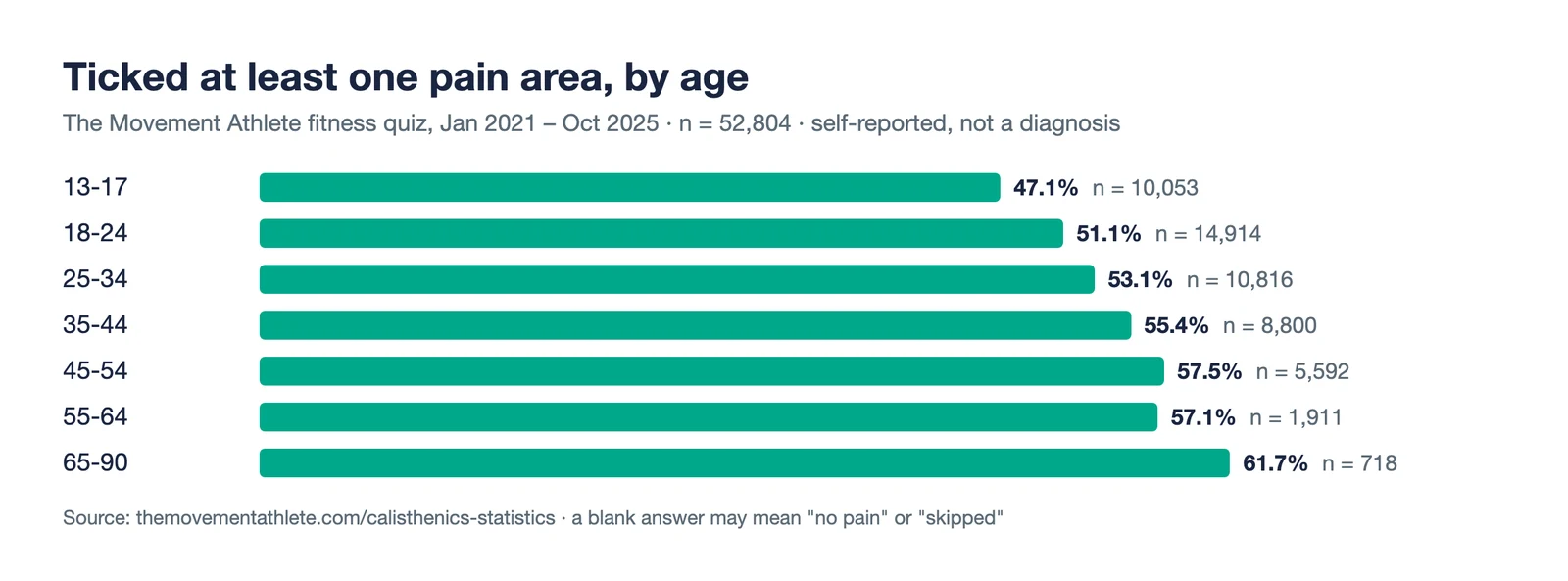
The share rises with age, dips slightly between 45–54 and 55–64, and peaks at 65–90.
Two other splits stand out. Women ticked a pain area more often than men (60.7% of 11,063 vs 50.3% of 41,741). And the least fit ticked one most: 62.3% of the 4,651 people who rated themselves “not fit at all”, against 49.1% of “very fit” and 49.7% of “experienced athlete” respondents.
Shoulders and wrists carry most calisthenics work, so your starting level matters. The free assessment shows yours on each movement, from push-ups to handstands.
Who is starting calisthenics: level, age and workout length
| Self-rated starting level (one choice) | Share |
|---|---|
| Not fit at all | 8.8% |
| New to exercising | 9.3% |
| From time to time | 19.1% |
| Regular | 32.1% |
| Very fit | 23.3% |
| Experienced athlete | 7.5% |
Over a third (37.2%) rated themselves in the bottom three levels.
| Age band | Share of respondents |
|---|---|
| 13–17 | 19.0% |
| 18–24 | 28.2% |
| 25–34 | 20.5% |
| 35–44 | 16.7% |
| 45–54 | 10.6% |
| 55–64 | 3.6% |
| 65–90 | 1.4% |
The median age is 26, and 23.6% were 40 or older. The sample is 79.0% male and 21.0% female.
Workout length wanted has a median of 45 minutes, but the spread is wide: 15.1% want 20 minutes or less, 25.1% want 21–30, 21.2% want 31–45, 26.4% want 46–60 and 12.1% want more than an hour. 40.2% want 30 minutes or less.
The 2026 quiz: what stops people, what they want most, and their weakest movement
This is a separate dataset, so don’t compare it with the one above. It comes from our newer quiz, which asks different questions with different age options (no under-18 option), and draws on different traffic. It covers 3 August to 12 November 2026. The obstacle question had 1,206 answers, one choice each.
| “What’s been your biggest obstacle?” | People | Share |
|---|---|---|
| Can’t stay consistent | 382 | 31.7% |
| Don’t know where to start | 375 | 31.1% |
| I plateau — no results | 212 | 17.6% |
| Pain or injury holds me back | 172 | 14.3% |
| Schedule makes it impossible | 65 | 5.4% |
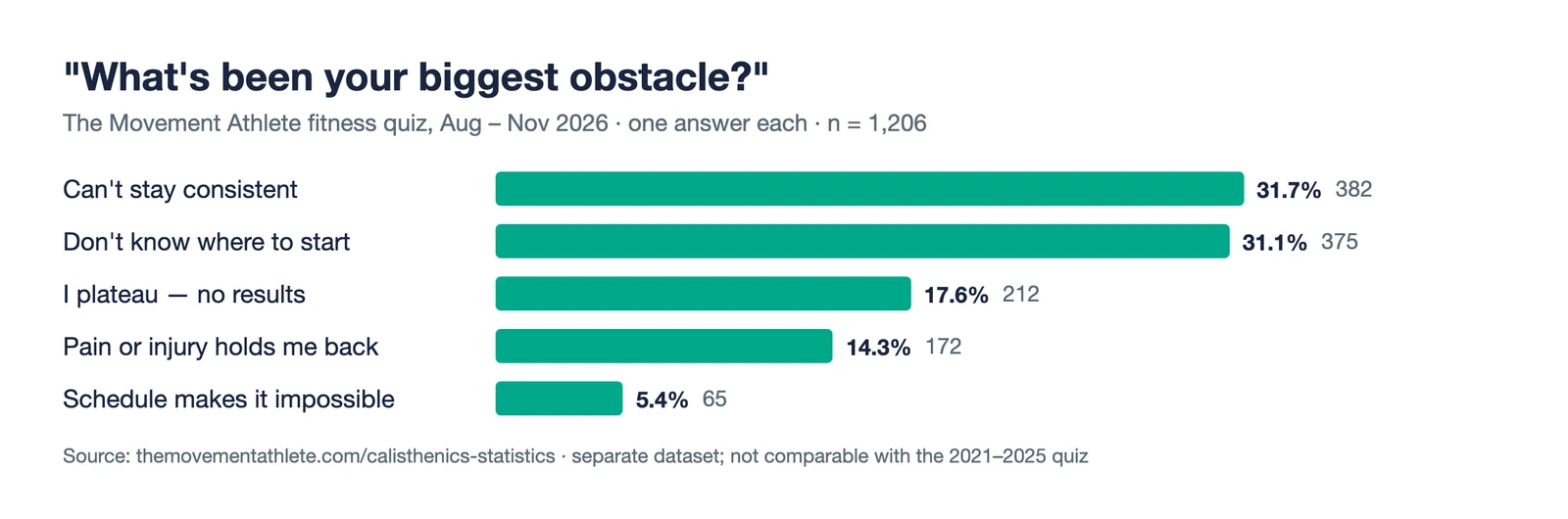
Not knowing what to do and not sticking with it are tied, at about 3 in 10 each. Time came last.
Pain as the main obstacle rises with age: about 8% of 18–24-year-olds (26 of 328) chose it, then about 12% at 25–34 (15 of 126), roughly 13% at 35–44, 16% at 45–54 and 19% at 55–64, and about 25% at 65 and over (33 of 130).
These groups are small, so trust the direction more than the decimals: the 65+ figure has a 95% confidence interval of about ±7.5 percentage points.
| “What would change your life most right now?” | Share |
|---|---|
| Lose fat and get leaner | 30.9% |
| Build more muscle with bodyweight | 21.1% |
| Master impressive bodyweight skills | 14.2% |
| Stay strong and mobile as I age | 11.4% |
| Move without pain or limitation | 9.4% |
| Build real strength without a gym | 6.8% |
| Just get fit — without the confusion | 6.2% |
Fat loss leads here, but this is a different question from the 2021–2025 goals table (one choice, different options), so the two rankings aren’t comparable.
The weakest fundamental people found in the quiz’s self-assessment was pull-ups, at 20.5% of 1,183 people. Then back 15.6%, dips 11.0%, handstands 10.9%, side 10.1%, squats 9.2%, push-ups 8.9%, plank 6.9% and abs 6.8%. Treat this one as an estimate: we haven’t confirmed how the quiz breaks ties, which could over-count some movements.
What this means for your training
If we were coaching you from these numbers alone, we’d change four things.
1. Prepare your shoulders and wrists before you load them
Shoulders and wrists were the two most-ticked areas, and they’re the two joints that carry you through every push-up, dip and handstand. So give them five minutes before you ask anything of them.
Wrists: on hands and knees, palms flat, fingers forward, slowly rock your shoulders past your hands and back, ten times. Then turn your fingers to face your knees and repeat with less lean. Aim for a forearm stretch; if the wrist pinches, lean less. Our wrist preparation guide goes further.
Shoulders: scapular push-ups. Hold a straight-arm plank, let your chest sink between your shoulder blades, then push the floor away until your upper back rounds slightly. Ten slow reps. Keep your arms straight the whole time. Only your shoulder blades move. For the rest of the session start, see our calisthenics warm-up guide.
If something hurts during or after training, that’s a question for a physiotherapist or doctor. A warm-up prepares joints for work; it doesn’t diagnose or treat anything.
2. Start at your real level on each movement
In the 2021–2025 quiz, over a third of people (37.2%) put themselves in the bottom three fitness levels. But one overall label hides a lot. You can be a “regular” trainee who can knock out clean push-ups and still be a beginner at pull-ups.
In our separate 2026 quiz, pull-ups were the movement picked most often as weakest (an estimate, as noted above). If that’s you too, our pull-up progression guide lays out the steps.
That’s why our skill tree splits the 9 fundamentals into 123 levels: 24 for abs, 19 for pull-ups, 14 for dips, 13 for plank, 12 each for push-ups and back, 11 for handstands, 10 for side and 8 for squats. Each level is a small step up from the last (here’s how our progressions work).
You can work out your own level on paper: for each movement, pick the hardest version you can do for clean reps with full control, and start one step below it. Or let us do the sorting. Our free assessment shows your starting level on each movement.
3. Let strength lead, and build mobility in alongside it
People ticked 2.87 goals on average, and build muscle and get strong sat on top. Both come from the same habit: when one version of a movement is clean and controlled, move to a slightly harder one.
Mobility fits inside that work too. The “become mobile & pain-free” option peaked in midlife, at 51.5% of both 35–44 and 45–54-year-olds, against 29.9% of 13–17-year-olds, and fell to 41.4% at 65–90. Train full range in every rep and give the warm-up and cooldown real time.
4. Plan for consistency before you plan for time
In the 2026 quiz, schedule was the rarest obstacle (5.4%). Staying consistent and not knowing where to start were the biggest.
Consistency comes from sessions you can finish. Train at the level where every set ends with clean reps, and move up only when that version feels controlled. Small steps you complete make the next session easier to start than one you failed halfway through.
A 30-minute session you can repeat three times a week beats an hour-long one you skip. In the 2021–2025 quiz, 40.2% of people already wanted 30 minutes or less. Fix your days in advance and know the session before you start.
How we got these numbers
- 2021–2025 quiz (Dataset A): our web fitness quiz, 5 January 2021 to 26 October 2025, one row per email (retakes aren’t visible). From 53,482 rows we removed 162 test or internal records and 516 impossible ages (outside 13–90), leaving 52,804. The pain-areas question was optional; goal, age, gender, level and session length were required.
- 2026 quiz (Dataset B): our newer quiz, 3 Aug – 12 Nov 2026. After 5 test records, 1,229 people remain. Age, gender and weakest fundamental exist only for those who reached the results screen (1,184 of 1,229; weakest fundamental n = 1,183).
- Survivor sample (Dataset B): contacts removed from our email platform before the 12 November pull are missing, so this is a survivor sample. The bias this introduces is unknown.
- Multi-select counting: for goals and pain areas, each percentage is the share of respondents who ticked that option, so those columns add up to more than 100%.
- Self-reported: levels, goals and pain areas are what people ticked, not measurements. A ticked pain area is not a diagnosis.
- Who’s in it: people who chose to take our online quiz, mostly English-language web visitors who found us through our own channels. They aren’t “all people” or “all calisthenics trainees”. Dataset A is 79% male and 19% under 18.
- Segment size: every group we report has at least 100 people. The smallest are 65–90 in Dataset A (718) and 25–34 in Dataset B (126). We publish aggregates only.
- No pooling: the two quizzes ask different questions of different traffic, so we never combine them or draw a trend between them.
- Progression counts come from our skill-tree data, checked on 12 November 2026.
Cite this data
You’re welcome to quote these figures with a link back to this page. Suggested citation:
The Movement Athlete Coaching Team (2026). Calisthenics Statistics: What 52,804 People Want From Training (and Where They Report Pain). The Movement Athlete, 12 November 2026. https://themovementathlete.com/calisthenics-statistics/
Frequently asked questions
What do most people want from calisthenics?
To build muscle. In our 2021–2025 quiz (n = 52,804), 66.9% ticked “build muscle” and 59.5% ticked “get strong”. Among people who picked only one goal, build muscle still led at 30.5%.
How many people starting calisthenics report joint pain?
Just over half (52.5%) of our 2021–2025 quiz takers ticked at least one pain area. The question was optional and its exact wording isn’t known, so blanks may mean “skipped”, and a tick is self-reported, not a diagnosis. The share rose with age, from 47.1% at 13–17 to 61.7% at 65–90.
Which body parts do people flag most?
Shoulders (25.3% of all respondents) and wrists (20.6%), then hips (13.4%) and ankles (11.3%). 36.5% ticked a shoulder or a wrist.
What stops people doing calisthenics?
In our 2026 quiz (n = 1,206), “Can’t stay consistent” (31.7%) and “Don’t know where to start” (31.1%) were the top obstacles. “Schedule makes it impossible” was the least common, at 5.4%.
How long do people want a calisthenics workout to be?
The median request was 45 minutes, but 40.2% wanted 30 minutes or less (n = 52,804, 2021–2025).
Find your own starting point
In the 2021–2025 quiz, most people wanted muscle and strength, and more than a third ticked a shoulder or wrist.
In the 2026 quiz, the top obstacles were not knowing where to start and staying consistent.
As coaches, we read those findings the same way: start at your real level on each movement, prepare the joints that carry you, and take small steps from there.
Take the free assessment to see where you stand.